
Commercial, Financial & Employment Disputes

DRT & SARFAESI

The SARFAESI Act, 2002 allows banks and financial institutions to enforce security without going to court once a loan account is classified as a non-performing asset. The Debts Recovery Tribunals hear borrowers’ challenges to these measures and lenders’ applications for recovery of debts.

Hanmat Lodhi Advocate outside the Debts Recovery Tribunal, Jabalpur
Debts Recovery Tribunal, Jabalpur

Matters handled

Section 13(2) demand notice
A notice requiring the borrower to discharge the liability within 60 days. The borrower may raise objections under Section 13(3A), and the lender must communicate its reasons for rejecting them.
Section 13(4) measures
Taking possession of the secured asset, taking over management, or appointing a manager, if the dues remain unpaid.
Section 14 proceedings
Applications by the lender to the Chief Metropolitan Magistrate or District Magistrate for help in taking physical possession.
Section 17 applications
Applications to the DRT by any person aggrieved by measures under Section 13(4), within 45 days. The DRT may set aside unlawful measures and restore possession.
Sale of secured assets
Notices of sale and auction under the Security Interest (Enforcement) Rules, 2002, and challenges to procedural defects.
Recovery applications
Original applications by banks under the Recovery of Debts and Bankruptcy Act, 1993, written statements, counter-claims and recovery proceedings.
Appeals to the DRAT
Appeals under Section 18 of the SARFAESI Act, which require a pre-deposit of 50% of the debt (reducible by the DRAT to 25%).

How proceedings typically run

  1. Review of notices and the account Section 13(2) and 13(4) notices, loan documents, statements of account and the date of NPA classification.
  2. Objections to the lender Where the Section 13(2) stage is open, a reasoned representation under Section 13(3A).
  3. Section 17 application Filed before the DRT having jurisdiction within 45 days of the measure, with any application for interim relief.
  4. Hearing before the DRT Reply by the lender, arguments and orders. No pre-deposit is required to file a Section 17 application.
  5. Appeal An appeal to the DRAT within the period prescribed, with the statutory pre-deposit.

Documents usually needed

  • Section 13(2) demand notice and Section 13(4) possession notice
  • Sale or auction notice, if issued
  • Loan agreement, sanction letter and security documents
  • Statements of account and repayment records
  • Any representation made under Section 13(3A) and the lender’s reply

Please do not send original documents or confidential material through this website. Documents are reviewed only after the chamber has agreed to consider a matter.

Watch

DRT & SARFAESI · In Hindi

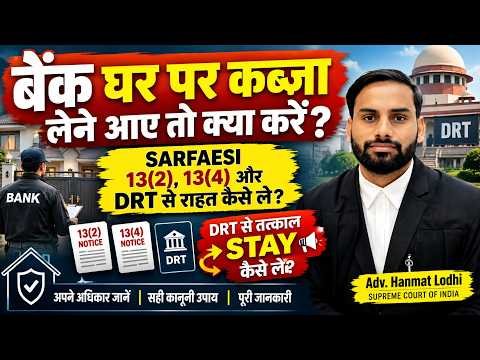
SARFAESI notices under Sections 13(2) and 13(4): approaching the DRT

An explanation of what the Section 13(2) demand notice and Section 13(4) possession notice mean for a borrower, and how the procedure before the Debts Recovery Tribunal works.
Watch on YouTube (external site)

DRT & SARFAESI · In Hindi

When a bank moves to take possession: challenging SARFAESI measures before the DRT

What a borrower can consider when a bank acts under Sections 13(2) and 13(4) to take possession of a home, and how relief is sought from the Debts Recovery Tribunal.

Watch on YouTube (external site)

Common questions

Can a bank take possession without a court order?

Under Section 13(4) of the SARFAESI Act a secured creditor can take possession after the 60-day notice period expires, without a court decree. It may seek the help of the Magistrate under Section 14 for physical possession.

How long do I have to approach the DRT?

An application under Section 17 is to be filed within 45 days from the date the measure under Section 13(4) was taken.

Can I file a writ petition in the High Court instead?

High Courts ordinarily decline to entertain writ petitions against SARFAESI measures because Section 17 provides an effective remedy before the DRT, as the Supreme Court held in United Bank of India v. Satyawati Tondon (2010).

Does SARFAESI apply to every loan?

No. Section 31 excludes certain cases, including security over agricultural land.

Related areas

General information only, not legal advice. The law stated is subject to change; reviewed by Hanmat Lodhi Advocate.

Professional enquiries

Contact the chamber

Enquiries are received by telephone and at the chamber. Please do not send confidential documents through this website or social media.

WhatsApp +91 90744 09228 (opens WhatsApp) Call +91 90744 09228

Before you continue

Disclaimer

The Bar Council of India does not permit advocates to advertise or solicit work. By proceeding, you confirm that you are seeking information about Hanmat Lodhi Advocate of your own accord, that there has been no advertisement, solicitation, invitation or inducement of any sort, and that nothing on this website constitutes legal advice or creates an advocate–client relationship.

Read the full disclaimer.